Outlook revised upwards in the wake of the pandemic
With the French economy turning out better than expected, growth is back on track: the +4.25% hoped for in the summer has risen to +6.25% according to the government. This outlook has prompted the digital sector to revise its forecasts upwards for 2021 as well.
While a -4.6% drop in sales was recorded between 2019 and 2020 for the digital sector, the situation for 2021 is much more favorable.
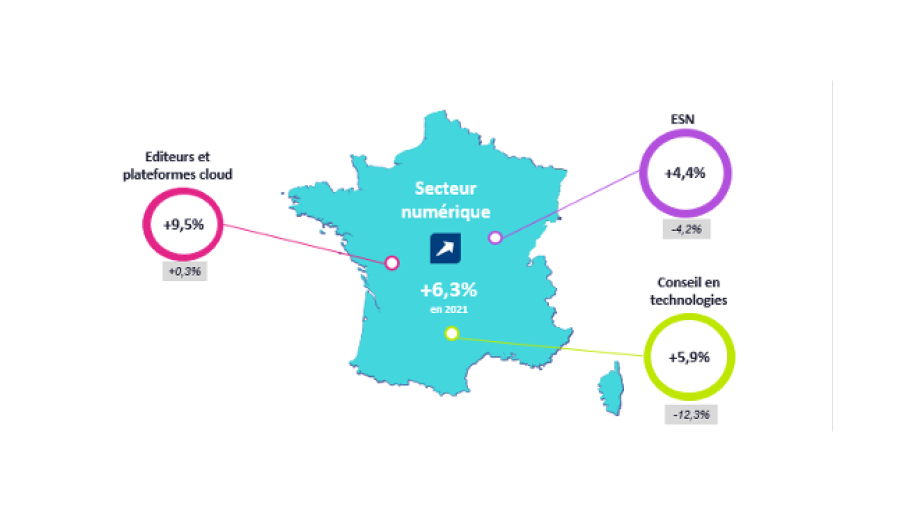
For the sector as a whole, Numeum has revised its initial growth forecast (from +4.8%) to +6.3% for 2021. This growth can be observed in every digital business:
- Estimated 2021 growth forcloud publishersand platforms: +9.5%.
- Estimated 2021 growth for Digital Service Companies (DSC): +4.4%.
- Estimated 2021 growth for Engineering and Technology Consulting (ICT): +5.9% .
2021: a strong recovery for the digital sector!
If a real rebound in growth was already announced in the first half of the year for the digital sector, the year 2021 closes with even more positive figures.
Growth in the digital sector continues to be largely driven by the cloud and its implementation in many companies. The current momentum of the French economy is reinforcing this, with digital investment projects up and running at higher levels than initially forecast for 2021. French companies are doing better, enabling them to continue or start their digital transformation, automate their business processes and strengthen the security of their information systems.
Initially estimated at 54.9 billion euros, the size of the digital market is now re-evaluated at 56.3 billion euros: 35% of the market for software publishers and cloud platforms with 19.3 billion euros in sales, 53% of the market for ESNs with 30.1 billion euros and finally 12% for Engineering and Technology Consulting with 6.8 billion euros.
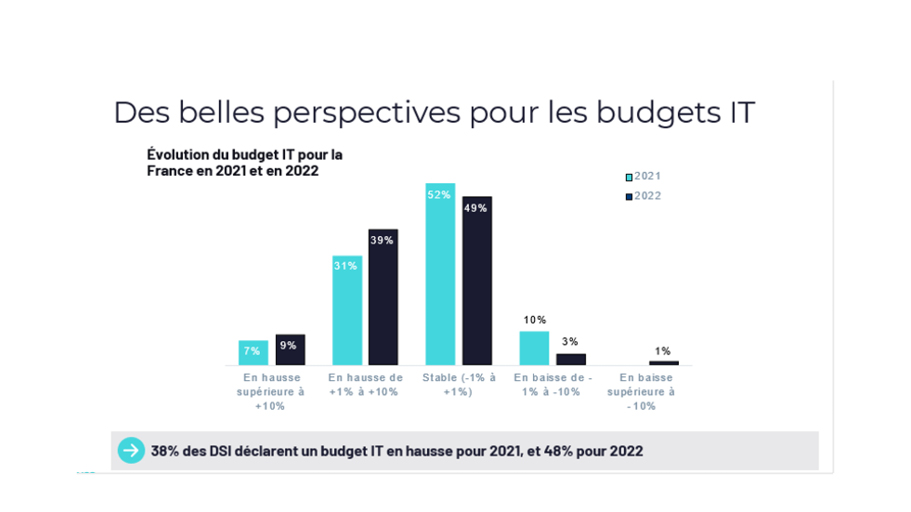
According to a survey of 100 CIOs conducted by PAC, group Teknowlogy, for Numeum, the return to growth is due in particular to higher IT budgets for 38% of CIOs in 2021. This growth will continue in 2022, with 48% of CIOs forecasting an increase in their IT budgets. Only 10% of CIOs will have reduced their IT budgets in 2021, and only 4% of CIOs anticipate a decrease in 2022.
Source: PAC, Teknowlogy Group for Numeum
This growth in IT budgets is also enabling CIOs to recalibrate their objectives: security, customer experience, data, Workplace and internal process optimization remain their top priorities. While cloud migration was CIOs’ top priority in the first half of 2021, improving IS security is now in first place, closely followed by improving customer experience. 67% of CIOs already use the cloud.
A sector in high demand for trained candidates
For the 11th year running, the digital sector continues to create jobs. Despite the health crisis, 4600 jobs were created in 2020. Digital sector salaried employees will total 538,262 in 2020 (sources BIPE, Numeum and ACOSS data).
In the second quarter of 2021, the gradual lifting of health restrictions stimulated workforce growth, which took off to reach a historic high in France, above the pre-crisis pace (+2.8% for the private sector as a whole, +3.1% for the digital sector alone) (sources BIPE, Numeum and ACOSS data).
The highly resilient software and services sector will account for almost 2.9% of salaried employment in 2020, compared with 2.8% in 2019.
From a regional point of view, 50.3% of digital sector employees work in the Ile de France region, a figure down on 2019. Between 2015 and 2020, jobs in the sector in the Atlantic seaboard regions (Brittany, Pays de la Loire, New Aquitaine) grew by more than 6%, while in Ile de France they increased by only 4%. Occitanie, heavily impacted by the aerospace crisis and accounting for 7.2% of jobs in the sector, will lose almost 1.1% of jobs by 2020.
Difficulties in filling available positions are increasing. The strong demand from digital companies to develop their activities is being met by a shortage of talent and people trained in the full range of skills needed to deploy the latest technological innovations and support the entire French economy in its digital transformation. Software and platform publishers are struggling to find R&D talent. ESNs are particularly looking for cloud and cybersecurity skills. ICT companies are looking for data analysis (Big data, AI…) and security skills.
5 key growth drivers to continue boosting France's digital sector
As established in the first half, 5 strong trends continue to drive the digital sector:
- Digital transformation(+10.8% growth in 2021, i.e. 6.9 billion euros): such as customer experience, e-commerce, dematerialization…
- Cloud C&SI- Consulting and systems integration (+28.1% growth in 2021, i.e. 12.2 billion euros): vertical clouds, globalized collaboration, widespread use of containers, modernization and transformation of apps/infra…
- Big Data(+23.4% growth in 2021, i.e. 1.9 billion euros): the collection and use of data to develop new business models and services…
- IoT (+21.6% growth in 2021 or 8.7 billion euros): the development of new solutions with 5G and edge computing…
- Security(+9.2% growth in 2021, i.e. 2.7 billion euros): with increased investment and outsourcing to counter the upsurge in risks, attacks…
Godefroy de Bentzmann and Pierre-Marie Lehucher
co-presidents of Numeum
” Having weathered the crisis well, the French digital market is now enjoying very promising growth, driven by the digital transformation of organizations. However, digital companies are still facing a major talent shortage. If we want to bank on the future, training must be a priority to counter the rapid obsolescence of technical skills and respond to the rapid evolution of the sector’s professions. “
rn