
“Europe does not want to be the technological “vassal” of the United States and China “*.
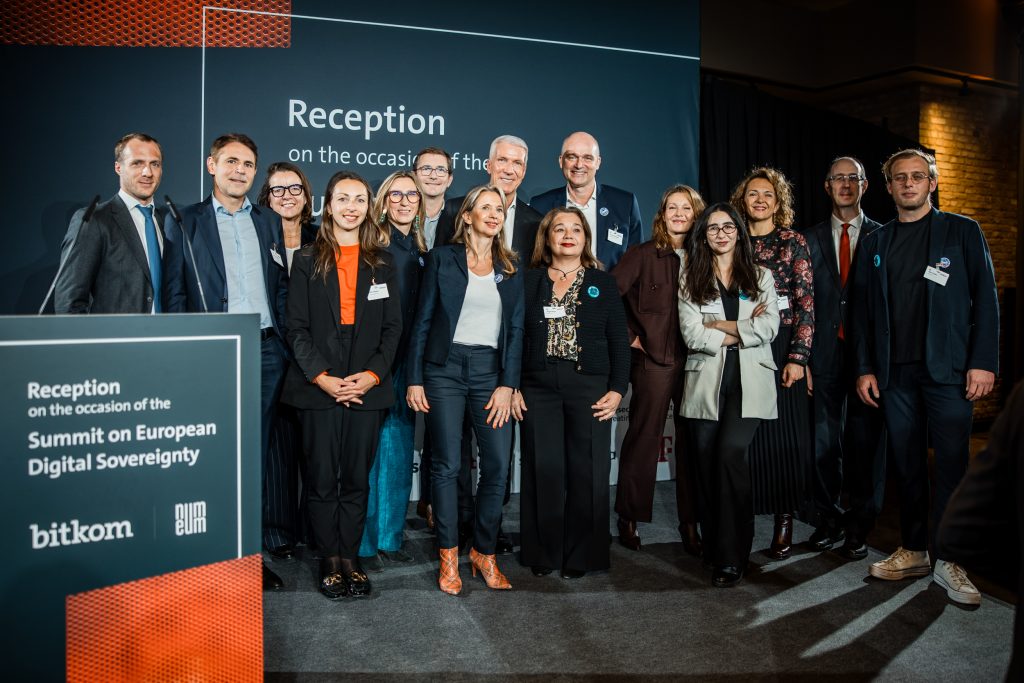
In Berlin, European digital sovereignty was at stake in two key events. On the one hand, a joint Bitkom-Numeum evening focused on networking, bringing together several hundred companies, public officials and experts to structure a Franco-German digital network. On the other, the summit on digital sovereignty, attended by several ministers and President Emmanuel Macron, set the first points of convergence in terms of strategies, financing, regulation and data.

Bitkom-Numeum: a growing European network
For the first time, the two leading professional organizations from France and Germany have taken the initiative of bringing together all digital stakeholders in one place.
Over 700 participants attended, including business leaders, ministers, European Commission representatives, experts, researchers, journalists and institutions. A veritable European “mini-forum” on digital technology.
The evening was a catalyst:
- meetings between French and German companies,
- first exchanges on AI, cloud and cybersecurity cooperation,
- cross-fertilization between public and private players,
- share feedback on common obstacles: financing, regulation, market access.
“Germany and Europe need to free themselves from unilateral dependencies and shape their digital future independently,” said Ralf Wintergerst. For Véronique Torner, President of Numeum, “momentum is building: it’s the right time to align our forces and create a real Team Europe”.
Beyond the declarations, the message is clear: digital sovereignty will be neither French nor German, it will be European.
Digital sovereignty: a summit to organize convergence
The next day, the scene changed, but the line remained the same. Announced at the Franco-German Council of Ministers in August 2025, the summit on digital sovereignty, co-organized by France and Germany, aims to give political structure to what ecosystems have begun to build on the ground.
On the French side, the Direction Générale des Entreprises (DGE), in conjunction with several ministries, is leading the preparations. On the German side, the Ministry of the Digital State (BMDS) plays an equivalent role. Together, they are working to ensure that national strategies are no longer juxtaposed, but begin to converge.
There are four main areas of focus:
- Industrial and digital strategies: aligning priorities, from cloud to AI, rather than multiplying isolated initiatives.
- Public procurement: using public purchasing as a driving force for European solutions.
- European financing and capital: channelling savings more effectively and securing investments over the long term.
- Data protection and circulation: guaranteeing security and sovereignty, without blocking uses or innovation.
Sovereignty is seen not only as an economic issue, but also as a security and defense issue, particularly in terms of cybersecurity and data.
“Think opportunities, not just risks
On stage, the political messages respond to each other.
German Minister Karsten Wildberger insists on the change of tempo: “Europe is ready to take action. There will be no sovereignty or competitiveness without mastering AI. We need to think opportunities, not just risks.”
Roland Lescure, on the French side, adds: “We need concrete action: funding, retention of European capital, earmarking of public orders, data protection.”
Henna Virkunnen, for the European Commission, reminds us that regulation must be a tool, not a brake: “Simplify to accelerate innovation, while preserving data quality. The Digital Omnibus Package is a key step, with massive investment in skills to accompany the AI Act.”
Underlying all this is the same equation: how can we reduce bureaucracy, modernize the state – particularly the federal state in Germany – and develop regulation so that it creates confidence without stifling business?

Macron: the alternative to dependency
In conclusion, Emmanuel Macron puts the debate back on the scale of the European project.
Europe,” he explains, “must develop its own alternatives if it is not to find itself in a vassal position, caught between American platforms and the might of China. Innovate, yes, but protect data. Accept that sovereignty and innovation have a cost, but remember that dependence has an even higher one.
The diagnosis has been accepted and the assets have been identified:
- a domestic market of 450 million consumers,
- an ability to attract more capital if the framework is clear,
- a wealth of talent and entrepreneurial energy,
- greater convergence with Germany,
- a high level of citizen protection,
- technology leaders – from SAP to Mistral – and structuring partnerships in AI and the cloud.
The question remains: how can we turn these assets into a sustainable competitive advantage?
Simplification, Innovation and capabilities, Protection and European preference: the EU agenda’s three priorities
In Berlin, a roadmap is taking shape around three key projects:
Simplification
Fighting over-regulation, adjusting texts like the RGPD without denying their spirit, and finally creating a true digital single market. The aim: to save time for businesses, without forfeiting the trust of citizens.
Innovation and capabilities
Train and attract talent, develop infrastructures (cloud, computing, networks), support R&D and accelerate the adoption of AI in businesses, including SMEs. The stated ambition: that the next generation of AI can emerge from Europe.
Protection and European preference
Limit the effects of extraterritorial regulations, strengthen data protection, support European storage and processing capacities, and restore fair competition. At the same time, we want to ensure European preference in both public and private purchasing decisions, where quality solutions exist.
The notion of “cognitive sovereignty” has also entered the debate: better protecting the youngest from global platforms, controlling the content that shapes opinion, and making regulation a tool for protecting democracy as much as the market.

From Berlin to “Echos
These two days in Berlin are a direct echo of the article published by Numeum in Les Echos: “Souveraineté numérique européenne: les constats ne suffisent plus, il faut passer à l’action”.
The findings are now widely shared: critical dependencies, lagging investment, market fragmentation, difficulty in nurturing champions. In Berlin, a further step was taken: recognizing that the challenge is no longer to diagnose, but to execute.
Convergence of strategies, oriented public procurement, secure financing, controlled data circulation, adoption of AI within a framework of trust: European digital sovereignty will be played out on these very concrete building blocks.
By bringing together both ecosystems and political decision-makers, the Bitkom-Numeum sequence and the summit on digital sovereignty show that a digital “Team Europe” is beginning to take shape.
And a message, following on from our article in Les Echos: the challenge now is to find out how quickly Europe can transform this political will into tangible results for its businesses, its citizens and its democracy.
*Emmanuel Marcon speaking at the summit on digital sovereignty
To find out more, read our article in Les Echos: https: //www.lesechos.fr/idees-debats/cercle/souverainete-numerique-europeenne-les-constats-ne-suffisent-plus-il-faut-passer-a-laction-2199241
